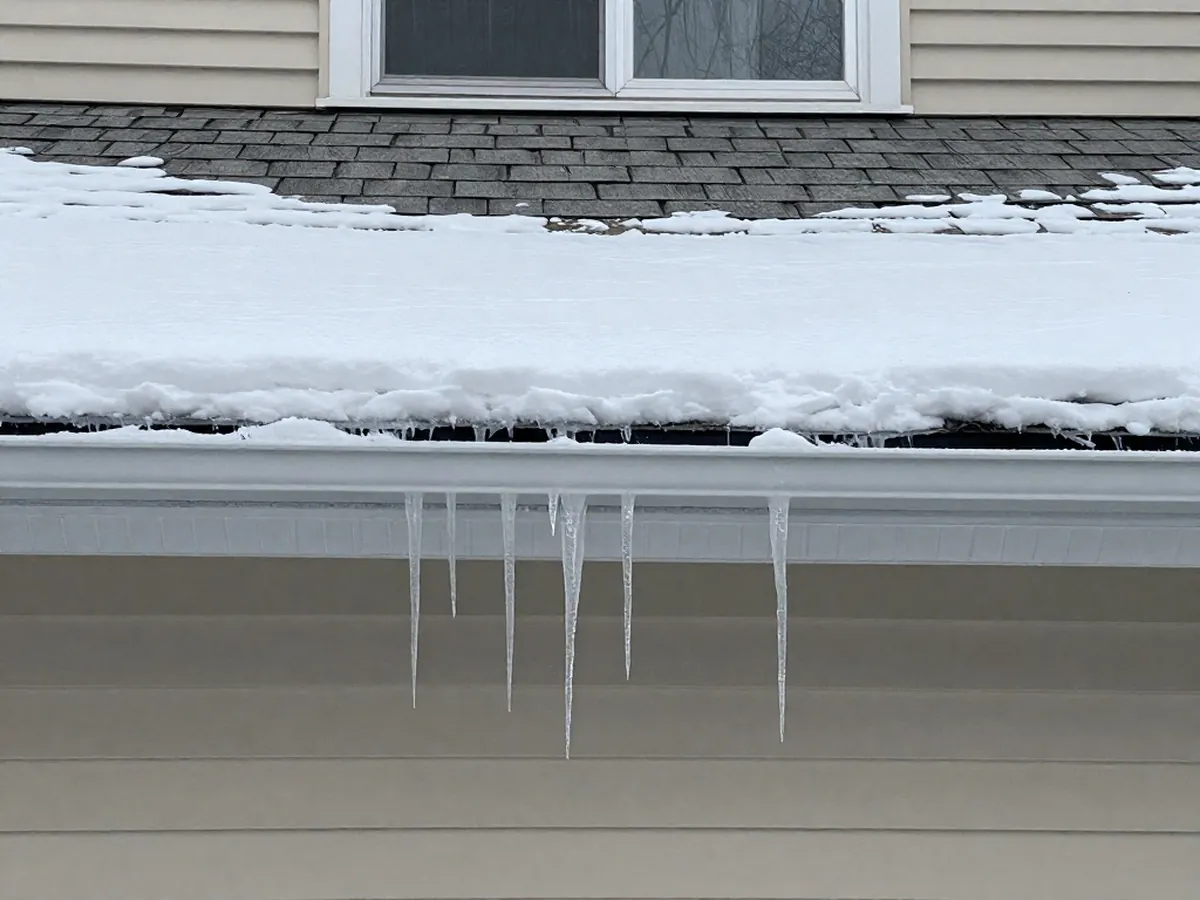

What winter asks of a roof
Newark's 1991-2020 normals: January 32.8 degrees and 9.1 inches of snow, February follows with 35.1 degrees and 10.1 inches of snow. Averages that close to freezing mean the roof sees thaw and refreeze again and again. Ice formations shift with the temperature, and the asphalt roofing trade group says that movement can abrade a membrane on a flat roof.
UMass names the three ingredients of an ice dam: snow, heat and cold. A checklist before winter is mostly about the middle one.
Twelve checks, in the order to do them
- From the yard, look along the ridge and edges for curled, cracked or missing shingles
- Look at the metal around the chimney, vents and walls for lifted or rusted pieces
- Clear the gutters and valleys of leaves and shingle grit
- Follow each downspout to where it lands, and send the water away from the foundation
- Check whether a downspout feeds a buried pipe, and whether that pipe drains
- From the attic hatch, look for daylight at the eaves and for wet or matted insulation
- Scan the rafters and the boards between them for dark streaks or frost
- Find air leaks around lights, the hatch frame and wire openings, and mark them to seal
- Check that insulation has not covered the vents at the eaves
- Photograph each finding with the date
- Decide in advance who gets the call if ice builds: a roofer, and 911 or the electric company for a wire
- Skip the ladder unless a check cannot be done any other way
Start in the yard
The asphalt roofing trade group's advice after Sandy was to inspect from the ground or through upstairs windows, and a pair of binoculars helps. Walk the house slowly. Look for shingles that are curled, cracked or missing, metal around the chimney that has lifted, and gutters that sag.
Photograph what you see, with the date. A dry day in late fall works well, before leaves hide the valleys.
Gutters, downspouts and the ground below
Clear leaves and shingle grit from the troughs. Rutgers Cooperative Extension reckons about 500 gallons reach the downspouts when an inch of rain falls on a roof of 800 square feet.
Follow each downspout to where it lands. EPA suggests redirecting them to landscaped areas that can absorb the water and checking local rules first, since some downspouts connect to underground pipes.
The attic, seen from the hatch
The Building America guide puts air leaks first on its list for ice dams: the gaps around lights, the hatch frame and wire openings that let house heat into the attic. It adds insulation at R-60 for climate zone 5 and colder, a 2-inch vent space above the insulation and balanced vents. UMass suggests R-38 and sealing every penetration.
From the hatch, look for daylight at the eaves, matted or wet insulation, frost, and insulation pushed over the vent openings. Mark leaks to seal.
Snow on the roof: what helps and what hurts
UMass says 1 to 2 inches of snow can form a dam on a poorly insulated roof. Hacking at ice is risky for the person and for the shingles. Roof rakes can scrape off granules, and heat tape appears in the same piece with caveats.
None of these treats the cause. Air sealing, insulation and ventilation do, and those are attic jobs for a dry week.
If a ladder is unavoidable
NIOSH asks for the ladder to extend 3 feet above the edge it leans against, for three points of contact while climbing, and for a distance of at least 10 feet from power lines. Do not set a ladder on ice, frost or soft ground.
The simplest ladder rule is to skip the climb. Most items on this list can be checked from the yard or the hatch.
Which item on the list is still unchecked?
Start with the first one you skipped. Ice dams explains what to do once ice is on the roof, and roof inspection covers a professional look.
Next step: call (862) 972-4008 with the item and what you saw.